
Study: Top 10 States With Carbon Monoxide Poisoning Deaths in the US Linked to Chimneys
Executive Summary
This study examines carbon monoxide (C.O.) poisoning-related deaths in the United States linked to the improper use or maintenance of chimneys. Using data from CDC and NFPA, the study gives insight into this public health issue, identifies patterns and contributing factors, and recommends regular chimney inspections, installation of carbon monoxide detectors, and public health campaigns to raise awareness on C.O. poisoning. Besides, South Carolina, Ohio, and Missouri report high death rates, with an older housing infrastructure being a critical contributory factor to the poisoning. With more than half of the top 10 states in the U.S. having a greater rate when compared to the globally standardized carbon monoxide poisoning rate of 0.353, the study recommends implementing regular chimney inspection and cleaning as an intervention to reduce poisoning fatalities and improve public safety.
A Study on Carbon Monoxide (C.O.) Poisoning Deaths in the U.S. Linked to Chimneys
- Introduction
Carbon Monoxide (C.O.) poisoning has continued to receive insufficient attention from healthcare experts, despite Stong (2023) noting an increase in fatality within the United States. According to Moberg (2023), while the globally standardized carbon monoxide poisoning rate in 2021 was 0.353, high-income North America had a 30.4% increase in mortality rate between 2000 and 2021, with the age-standardized mortality rate in 2021 standing at 0.314 per 100000 residents. The Center for Disease Control and Prevention (2017) note this issue, stating that despite data limitation across the states, the increasing public health surveillance has continued to prove an expanding scope in this problem, with at least 420 Americans dying each year from accidental carbon monoxide poisoning (CDC, 2023). With chimneys one of the most common contributory factors for unintentional carbon monoxide poisoning, healthcare researchers have continued to develop interventions to enhance prevention, education, and evaluation efforts to curb these increasing rates.
- Purpose of the Study
Understanding chimney-related carbon monoxide poisoning is crucial to making informed public health decisions. Therefore, this study will;
- Investigate the incidence of carbon monoxide poisoning deaths in the United States of America that are linked to chimney use and maintenance.
- Significance of the Study
Referred to as the ‘silent killer’ due to its colorless, odorless nature, this study will highlight the dangers of carbon monoxide poisoning and help improve the public’s safety awareness. Besides, understanding the prevalence will be crucial to informing public safety campaigns, encouraging the adoption of preventive measures, and updating safety regulations.
- Methodology
Guided by the question, ‘What are the top contributing factors to carbon monoxide poisoning deaths linked to chimneys in the United States, and how do these vary across different states?’ this section outlines the data collection and analysis to make the study transparent and reproducible.
2.1 Data Collection
This research draws from various sources, including the Center for Disease Control and Prevention, the National Fire Protection Association, and other State Health Departments, to ensure a comprehensive data collection. Structured to identify chimney-specific C.O. poisoning, the study identifies the total number of C.O. poisoning deaths in each state, those specific to chimney-related incidents, and population figures for each state to standardize the comparison across the states. CDC, NFPA, Lancet Public Health Research Publications, the
Fire Protection Research Foundation and the U.S. Fire Administration provided the morality, insight, and rates across various states.
2.2 Data Analysis
The study then organized this information by state, including total C.O. deaths, chimney-related deaths, and population figures. Besides, this data served as the foundation for calculating the rate of C.O. deaths linked to chimneys per 100,000 residents, allowing standardization when adjusted for population size while providing valuable insights into relative risks. The formula below was crucial to finding the rate;
Rate=Number of Chimney Related DeathsTotal Population* 100,000
- Results
CDC Query Panel on the average annual number of deaths from C.O. poisoning over five years (2017-2021) shows that while the state of Delaware and Connecticut has the lowest number of deaths due to C.O. poisoning, Texas and Florida have the highest reported cases. Figure 1 below shows the mortality rate distribution across the country.
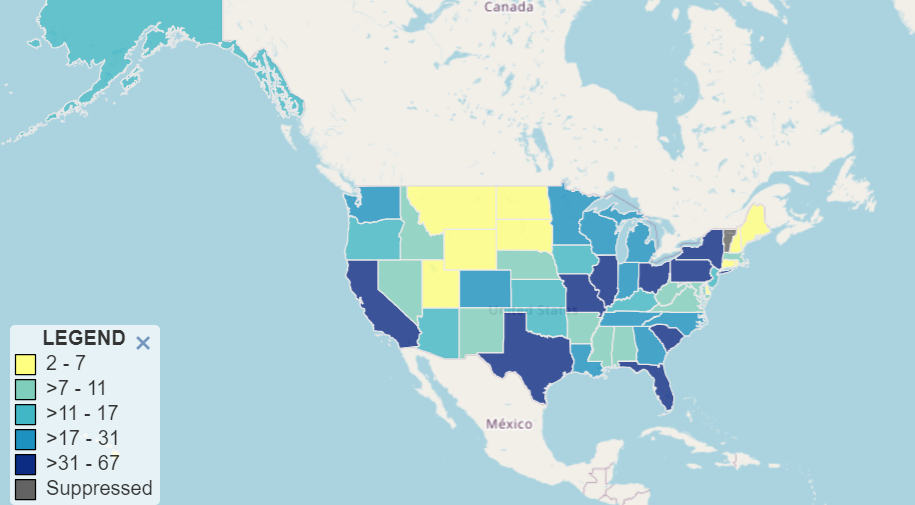
Figure 1: A Map of Unintentional Carbon Monoxide Poisoning Mortality in the USA.
Besides, the highest recorded average number is from Texas (67), Illinois (66), and Ohio (65), while the state with the lowest recorded number of deaths is Hawaii (2), New Hampshire (2), and Delaware (3). Figure 2 below shows the annual average mortality rates across the states from 2017-2021.

A look into the top 10 number of reported deaths shows Texas with (67 cases), Illinois (66), and Ohio (65), California (64), Pennsylvania (56), Florida (49), South Carolina (35), Missouri (34), New York (32), and Tennessee (31). Table 1 below shows the average number of deaths and the rates per 100,000 people across the 10 states (CDC, 2024; United States Census Bureau, 2024; Milke & McAllister, 2022).
| State | Average Number of Deaths (2017-2021) | Total Population in Millions | Rate per 100,000 |
| Texas | 67 | 30,503,301 | 0.22 |
| Illinois | 66 | 12,549,689 | 0.53 |
| Ohio | 65 | 11,785,935 | 0.55 |
| California | 64 | 38,965,193 | 0.16 |
| Pennyslavania | 56 | 12,961,683 | 0.43 |
| Florida | 49 | 22,610,726 | 0.22 |
| South Carolina | 35 | 5,373,555 | 0.65 |
| Missouri | 34 | 6,196,156 | 0.55 |
| New York | 32 | 19,571,216 | 0.16 |
| Tennessee | 31 | 7,126,489 | 0.43 |
With the total population varying across every state, South Carolina, Missouri, and Ohio, states report the highest rates of chimney-related C.O. poisoning deaths, with 0.65 for South Carolina and 0.55 deaths per 100,000 residents for Missouri and Ohio. Besides, Texas (0.22 per 100,000 People) and Pennsylvania (0.43 per 100,000 People) have moderately high rates of C.O. poisoning deaths, while California and New York have the lowest rates (0.16 per 100,000 People).
- Discussion
4.1 Analysis of Results
Analyzing carbon monoxide (C.O.) poisoning deaths across ten U.S. states reveals significant variation in the rates of deaths per 100,000 residents between 2017 and 2021. Figure 3 below shows the top 10 states with high carbon monoxide poisoning deaths linked to chimneys per 100,000 residents.
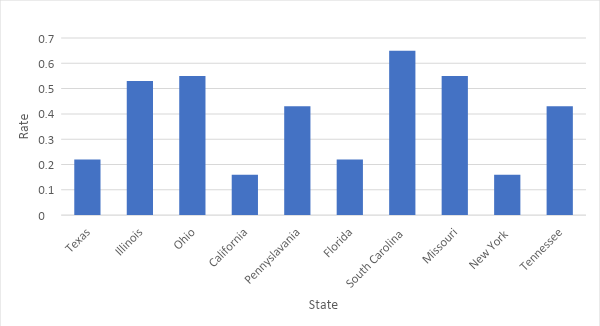
This phenomenon suggests that these states have underlying risk factors that make residents more susceptible to C.O. poisoning from chimneys. According to the South Carolina Department of Environmental Services (2024), while state regulations require individuals to install carbon monoxide detectors, state policies focusing on newly constructed Group-R and Group-I occupancies may explain the increasing rates. Besides, the Missouri Department of Health and Senior Services (2024) cites poorly maintained chimneys as the leading contributing factor to C.O. poisoning within the states, noting that despite the adopted policies, few users understand the correct chimney use. This phenomenon calls for developing policies focused on human behavior to help change habits and actions that increase the risk of C.O. exposure. Besides, it creates a need for robust public safety campaigns and stricter building codes to mitigate the risks of C.O. exposure and protect vulnerable populations.
4.2 Recommendation
C.O. poisoning remains a preventable but persistent issue that will require aggressive efforts to address. With the obstruction within the chimney leading to the accumulation of combustion gases or a broken chimney connector pipe responsible for the majority of carbon monoxide exposure, there is a need for public awareness campaigns focused on chimney use and maintenance. States with higher rates have to enact policies that mandate regular chimney inspections and installing C.O. detectors in homes. Besides, there is a need to offer training on safe practices to address behavior-based risks
- Conclusion
6 of the 10 states with the highest carbon monoxide poisoning deaths linked to chimneys have a rate higher than the global standardized rate of 0.353, necessitating a need to address gaps in safety measures and raise awareness about the dangers posed by chimneys. States with higher rates should consider enacting policies that mandate chimney inspections, sweeping to avoid blockages, and the installation of C.O. detectors in homes to mitigate the risks of C.O. poisoning. There is a need to promote preventive measures and collaborative efforts between public health officials, policymakers, and homeowners to protect the public from this often-overlooked danger.
References
CDC. (2017). QuickStats: Number of deaths from unintentional carbon monoxide poisoning,* by month and year — National Vital Statistics System, United States, 2010–2015. MMWR Morbidity and Mortality Weekly Report, 66(8), 234. https://doi.org/10.15585/mmwr.mm6608a9
CDC. (2023). National Environmental Public Health Tracking Network Data Explorer. https://ephtracking.cdc.gov/DataExplorer/?c=2&i=39&m=-1
Center for Disease Control and Prevention. (2024). Indicator: Unintentional Carbon Monoxide Poisoning Mortality. National Environmental Public Health Tracking Network. https://ephtracking.cdc.gov/indicatorPages?selectedContentAreaAbbreviation=2&selectedIndicatorId=39&selectedMeasureId=
Milke, J., & McAllister, J. (2022). Carbon Monoxide Incidents: A review of the data landscape. In National Fire Protection Association (NFPA). https://www.nfpa.org/education-and-research/research/fire-protection-research-foundation/projects-and-reports/carbon-monoxide-incidents-a-review-of-the-data-landscape
Missouri Department of Health and Senior Services. (n.d.). Missouri Carbon Monoxide Poisoning Surveillance. https://health.mo.gov/living/environment/carbonmonoxide/pdf/co-statistical-report.pdf
Moberg, M. (2023). Global, regional, and national mortality due to unintentional carbon monoxide poisoning, 2000–2021: Results from the Global Burden of Disease Study 2021. The Lancet Public Health, 8–e839-49. https://doi.org/10.1016/ S2468-2667(23)00185-8
South Carolina Department of Environmental Services. (2024). Carbon Monoxide. State of South Carolina. https://scdhec.gov/environment/your-home/carbon-monoxide#:~:text=Symptoms%20of%20CO%20poisoning%20include,800%2D222%2D1222).
Stong, C. (2024, May 15). Unintended carbon monoxide poisoning deaths rose in the U.S. but fell globally – Pulmonology Advisor. Pulmonology Advisor. https://www.pulmonologyadvisor.com/news/unintentional-carbon-monoxide-poisoning-deaths-2000-2021/
U.S. Fire Administration. (2019). Data sources and national Estimates Methodology Overview for the U.S. Fire Administration’s Topical Fire Report Series (Volume 20). U.S. Department of Homeland Security.
USAFacts. (2023, November 22). Is carbon monoxide still a problem in the U.S.? – USAFacts. USAFacts. https://usafacts.org/articles/is-carbon-monoxide-still-a-problem-in-the-us/